Abington Superior Roofing handles flat roof repair in Abington, PA on rear additions, enclosed porches, attached garages, row homes and small commercial buildings, serving surrounding cities including Lower Moreland, Upper Southampton, East Goshen, Warwick Township and Plymouth Township. With more than 20 years of roofing in this area, we see the same flat-roof failures again and again, and most of them are fixable without replacing the whole roof.
Flat roofs are not truly flat; they are low-slope roofs that drain slowly. That slow drainage is why their problems are different from a shingled roof’s. Water sits longer, seams carry more of the load, and a leak can travel across the deck under the membrane before it shows on the ceiling below.
We start by finding where water actually enters, check the insulation for moisture, and repair the membrane with matched material. If the roof has reached the end of its life, we say so and explain why, rather than patching it indefinitely.
Flat Roofs on Houses in This Area
Rear Additions and Kitchen Bump-Outs
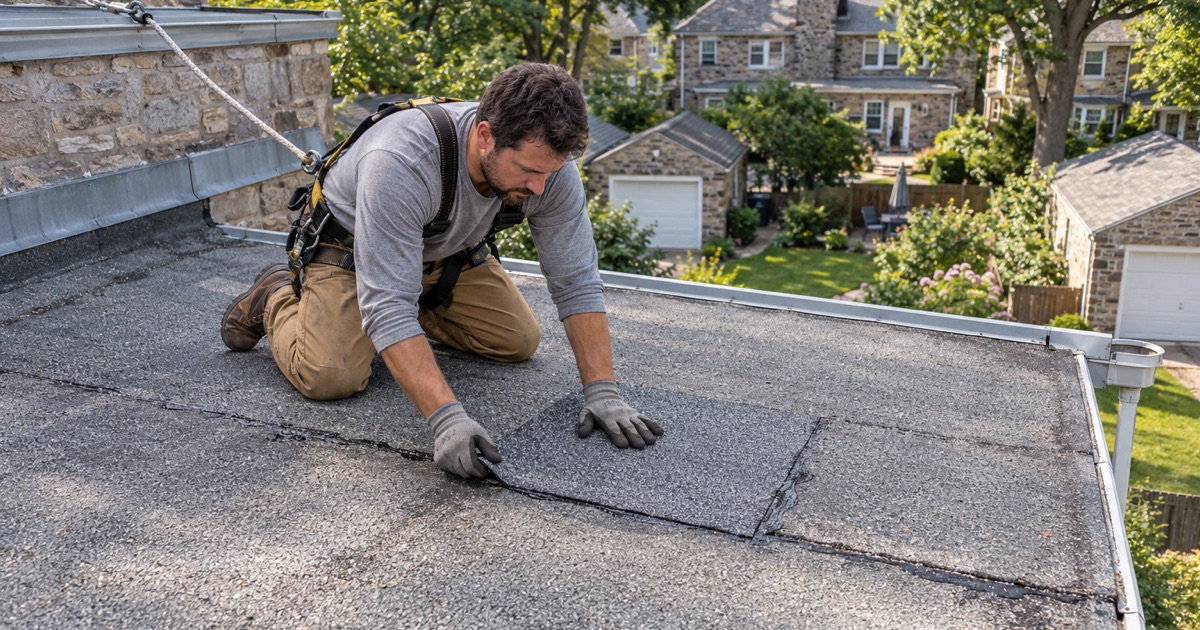
Many houses here have a rear addition or kitchen bump-out with a nearly flat roof that meets the main house below a window or along a wall. The joint between the two is where most of these roofs leak, especially when the original flashing was simply tucked under siding.
We rebuild that wall flashing with membrane turned up the wall and counter flashing over it. When the addition roof itself is sound, fixing that joint often ends a leak the owner has lived with for years.
Porch and Garage Roofs
Enclosed porches and attached garages commonly have low-slope roofs covered with roll roofing, modified bitumen or rubber. Foot traffic during gutter cleaning, fallen branches and years of sun wear them out at different rates.
We repair punctures, worn spots and open laps on these roofs and check the edge metal and gutter connection. A small porch roof costs little to repair properly and a lot to ignore once the framing underneath gets wet.
Row Homes and Attached Flat Roofs
Attached homes often share a continuous low-slope roof divided only by property lines. A leak on one roof can come from the neighbor’s side, and a repair on one side has to tie neatly into the other.
We find where the water is entering, even if it crosses a party wall, and make the repair with the neighboring roof in mind. When the source is on the other side, we explain that clearly so you can talk with your neighbor.
Common Flat Roof Failures We Repair
Open Seams and Laps
Every flat roof membrane is joined at seams, and those seams are where most leaks begin. Adhesives age, heat welds fail, and movement in the building pulls laps open a little at a time.
We clean, prime and reseal open seams with materials compatible with the existing membrane. Where a seam has failed along its length, we cover it with a new strip rather than relying on more adhesive.
Blisters, Splits and Punctures
Blisters form when moisture or air trapped under the membrane expands in the sun. Some are harmless, but blisters that split open let water straight in. Punctures come from foot traffic, tools and debris.
We cut out split blisters, dry and patch the area, and repair punctures with matched membrane. We also probe around each repair, since a split blister often means moisture is already under the roof.
Failed Wall and Curb Flashing
Wherever a flat roof meets a wall, a chimney, a skylight curb or a vent, the membrane has to turn up and be sealed. These transitions take movement and weather, and they fail far more often than the field of the roof.
We rebuild failed flashing with new membrane carried up the wall and protected by counter flashing or termination bar. This is the most common repair we make on flat roofs, and the one that most often ends a long-running leak.
Ponding Water and Clogged Drains
Water that stands for days on a flat roof wears the membrane faster and works its way into any weak seam. Clogged drains, blocked scuppers and sagging decking are the usual causes.
We clear drains and scuppers, reflash them, and identify low spots. Where ponding comes from a deeper problem, such as a sagging deck, we explain the options for correcting it during a future replacement.
Repair Materials Matched to Your Roof
Modified Bitumen Repairs
Modified bitumen roofs, applied by torch or adhesive, are repaired with compatible cap sheet and the same application method where it is safe. Granulated surfaces are matched so the patch weathers with the rest of the roof.
On houses with wood framing close to the roof surface, we use cold-applied or self-adhered methods rather than an open flame. Safety decides the method on every job.
EPDM and TPO Repairs
Rubber EPDM roofs are repaired with EPDM patches, primer and seam tape, and TPO roofs with heat-welded TPO. Using the wrong material, such as asphalt cement on rubber, damages the membrane and fails quickly.
We identify the existing membrane before choosing the repair material. That simple step is the difference between a patch that bonds and one that peels off by summer.
When Repair Becomes Replacement
A flat roof with dry insulation and isolated failures is worth repairing. One with wet insulation across large areas, cracks throughout the surface, or seams failing everywhere is not.
We show you what we found, including probe results and photos, and explain whether repairs will hold or simply delay a replacement. The decision stays yours, made with the facts in front of you.
- 20+ Years in Roofing
- Free Written Estimates
- Line-by-Line Scopes