Abington Superior Roofing approaches roofing in Lansdowne with more than 20 years of trade experience and one habit that matters here: we settle who needs to see a roof plan before we settle the price. On many homes that list is short. On a building facing the borough’s commercial streets it can include a review board and Borough Council, and the schedule has to reflect that.
A leak call starts the same way wherever the building sits. We go up on the roof and into the attic, follow the stain back to the point where water actually enters, and only then talk about cost. If a repair will hold, you hear that first, plainly, before anyone mentions tearing anything off. Replacement comes up only when the roof has truly run out of good repairs.
When replacement is the answer, the estimate breaks tear-off, decking, underlayment, flashing, ventilation and gutters into separate lines, so a second quote can be set beside ours and compared item for item. Contracts follow Pennsylvania’s home improvement law, including the three-business-day cancellation notice and a deposit kept inside the legal limit. None of that paperwork changes when the address falls inside a historic district.
Lansdowne’s Historic District on Lansdowne and Baltimore Avenues
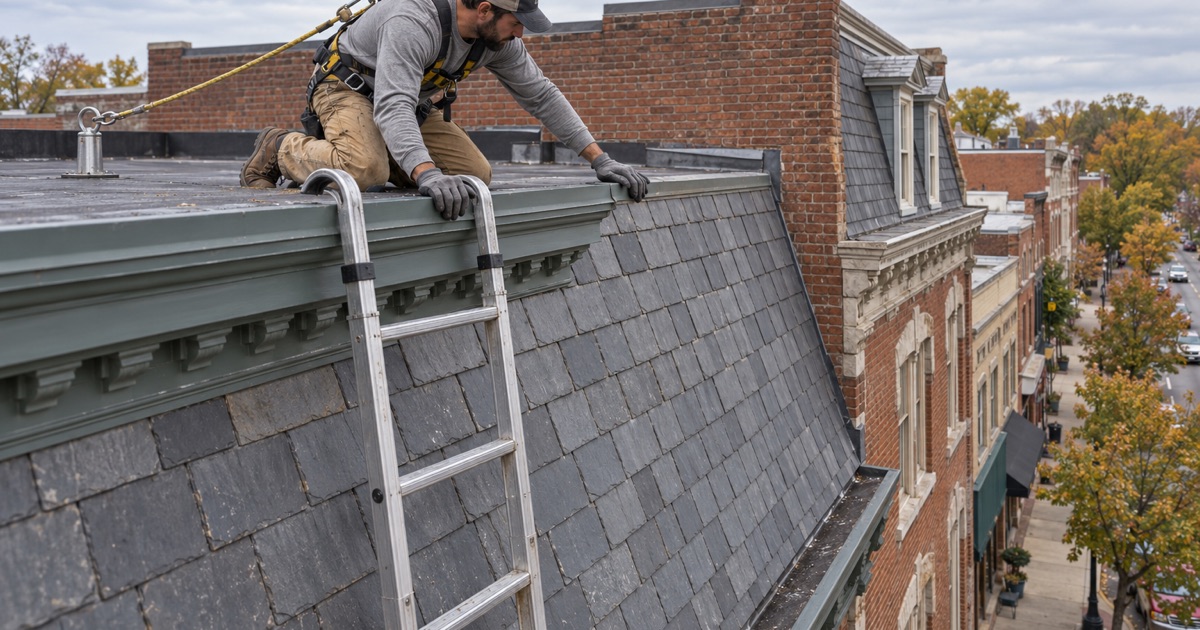
Lansdowne is a borough of 1.18 square miles in Delaware County, 6 miles southwest of Center City Philadelphia. Its locally regulated historic district is not a residential enclave. It is the business corridor, the commercial frontage along two avenues, and that is where a roof stops being a private matter between an owner and a contractor and becomes part of what the borough reviews.
Where the district boundary runs
Borough Code chapter 203, adopted on October 18, 2006 as Ordinance 1220, drew the district along two frontages. On Lansdowne Avenue it runs from Stewart Avenue to Nyack Avenue. On Baltimore Avenue it runs from Owen Avenue to Maple Avenue. The borough’s own description also takes in parcels adjacent to and visible from the public right of way, so the line is about sight as much as street numbers.
That boundary is the first thing we check when a call comes from an address on either avenue. A parcel set back from the frontage can still fall inside if it sits adjacent and can be seen from the street, which is why we confirm with the borough rather than guess from a map. The answer decides whether the job is planned around a review calendar or around the roof alone.
Local district versus National Register
Lansdowne also has listings on the National Register of Historic Places, among them the Lansdowne Park Historic District, the Henry Albertson Subdivision and the Lansdowne Theatre. Owners sometimes assume those listings are what trigger review of a roof. They are a federal recognition of historic value, and they are a separate thing from the district the borough itself created by ordinance.
The difference matters when a roof is being planned. Local review comes from the borough’s own code and applies to the corridor frontages. A National Register listing on its own does not create a borough review, and whether either Register district overlaps the corridor is something we confirm address by address rather than assume in either direction.
Looking for roofing closer to Towamencin? See Roofing Services in Towamencin.
What the Review Board Looks At, and Who Decides
The borough’s page for its Historic Architectural Review Board is short and direct: properties in the historic central business district must have all exterior renovations and signage reviewed by the board. A roof on a building visible from Lansdowne Avenue or Baltimore Avenue is part of that exterior. We read the rule that way and plan as though review applies until the borough tells the owner otherwise.
Is a re-roof an exterior renovation?
We have not read the district’s design standards, which sit in the zoning code, so we never tell an owner what material or color the board will favor or whether it will ask questions about a given roof. What we can say is that the question belongs with the borough before a contract is signed, not after a tear-off date is booked.
That holds even for a like-for-like replacement. Swapping worn shingles for new ones of the same look can feel like routine upkeep, yet the borough’s text speaks about exterior work broadly. A call to Borough Hall on East Baltimore Avenue settles whether a filing is needed for that particular building, and the answer goes into our schedule the day the owner hears it.
Once a month, on a Thursday evening
The board meets on the fourth Thursday of each month, in the evening, at Borough Hall. One meeting a month means timing is not a detail. An application that misses one cycle waits for the next month’s meeting, and a roof that needed attention in spring can slide into summer if nobody counted backward from the meeting date when the job was first discussed.
Recommendation first, then Borough Council
The review board does not hand out the approval itself. It makes a recommendation to Borough Council on whether a Certificate of Appropriateness should be issued, and Council makes the decision. For an owner that means two public steps rather than one, and we build both into the calendar we give you instead of treating the board’s meeting as the finish line.
The borough’s construction permitting page lists the Certificate of Appropriateness, where one is needed, among the prerequisite approvals that come before the trade permit. So the order on a corridor building runs review board, then Council, then any permit the work requires, then the crew. We do not put a tear-off date on a contract until the steps ahead of it are realistically in view.
Planning a Roof on a Corridor Building Seen From the Street
On Lansdowne Avenue and Baltimore Avenue the roof is planned around a review calendar as much as around the weather. That changes how we sequence a job, what we put in writing early, how we treat the details a passerby can see, and what we do with a roof that cannot wait for the next monthly meeting.
Documenting the roof before anything is filed
Before any filing, the owner needs a clear record of what is up there now. We photograph the visible slopes from the sidewalk and from the roof, note the existing material, edges and flashing, and look in the attic for where water has been getting through. That record lets the owner describe the existing condition and the proposed work without guesswork.
The scope we hand over separates the parts of the job a passerby sees from the parts nobody ever will. Roofing material, drip edge, flashing at a wall or chimney and the gutter line all show from the street. Underlayment, decking and ventilation do not. Keeping the two groups distinct makes it easier to answer questions about the visible work without reopening the whole estimate.
Slate, flashing and other visible details
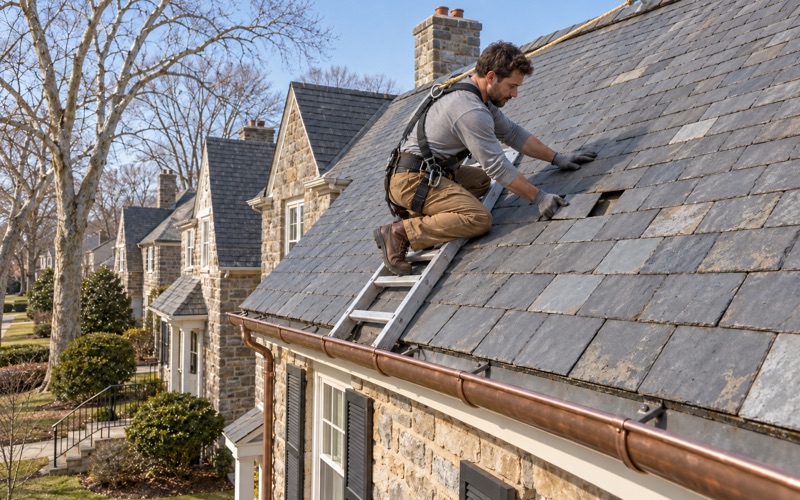
Where a corridor building carries slate, our first move is repair. Broken or slipped pieces are replaced one at a time, set with copper nails and slate hooks, and a sound slate roof is not written off because a handful of pieces failed. On a building under review, keeping a sound roof in service can be the simplest path, since repair leaves the visible surface much as it was.
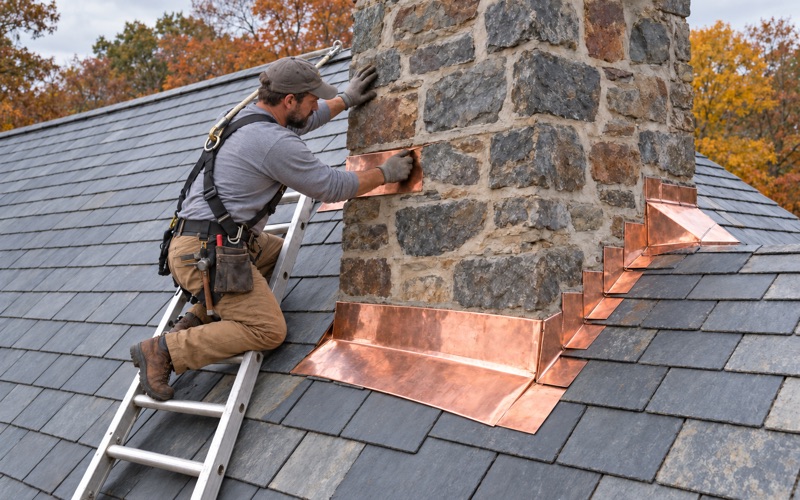
Flashing is the exception to keeping things as they are. When a roof is replaced, we replace the step, counter and chimney flashing with it instead of reusing tired metal under new material. Gutters and downspouts are sized and pitched with the roof as well, so the edge a pedestrian looks up at is planned as one piece rather than patched together afterward.
When a leak cannot wait for the meeting
A roof leaking into a shop below does not pause for the fourth Thursday. In that case we stop the water with temporary measures that change nothing permanent, document what we found, and then plan the lasting work through the borough’s process. We would rather ask the borough what it expects for an urgent repair than assume an emergency excuses the review.
Homes on Lansdowne’s Historic Resource Survey
Away from the two avenues, most Lansdowne roofs sit on houses rather than storefronts, and the borough treats them differently. Its review board page notes that homes on the Historic Resource Survey may also have special guidelines. That phrase is narrower than the corridor rule, and we treat it as a reason to ask the borough a question, not as a blanket requirement on every house.
Checking a house against the survey
When an owner calls about a house, we ask whether it appears on the survey or whether a previous owner was ever told it does. If there is any doubt, the borough is the place to confirm it before a scope is final. A house off the survey is planned around the roof, the attic and the water path, the same as anywhere else we work.
If the house is on the survey, we ask the borough what its guidelines mean for that roof before a material is chosen, and we write the answer into the scope so nobody relies on memory later. The owner keeps that note with the contract, which helps if the question comes up again with a future buyer or a later project on the same house.
Decking surprises and storm claims
When the old roof comes off and decking underneath turns out to be rotten, we photograph it and show the owner before a single sheet is replaced, at the per-sheet price already set in the contract. Those photos stay with the job record, so there is never a question afterward about what was found under the old material or why the bill changed.
Storm damage gets the same care with a camera. We photograph and write up what we find for the owner’s own insurance claim, and when asked, we will meet the adjuster on site to walk the roof together. We do not negotiate the claim itself; that conversation stays between the owner and the insurer, where it belongs.
Leaving the street the way we found it
At the end of each work day the driveway, yard and gutters are cleaned, and the ground is swept with a magnet for stray roofing nails. On a corridor frontage the sidewalk gets the same sweep, because people walk past the building all day and a dropped nail on a busy avenue is a problem for neighbors, not only for the owner.
- 20+ Years in Roofing
- Free Written Estimates
- Line-by-Line Scopes