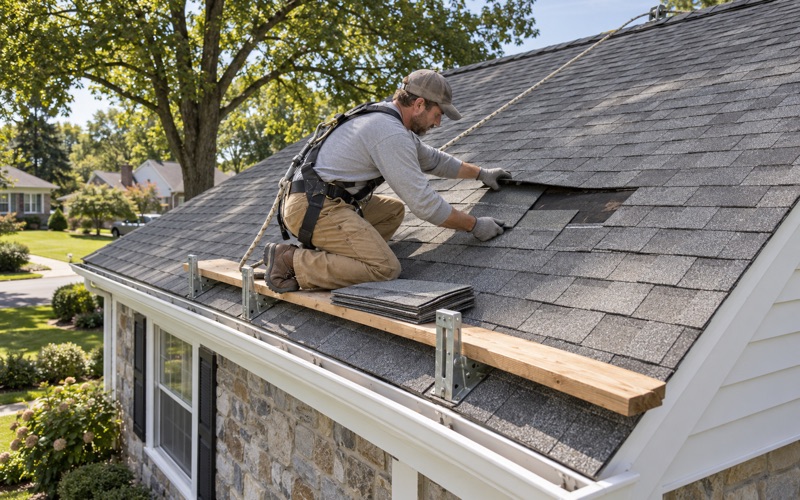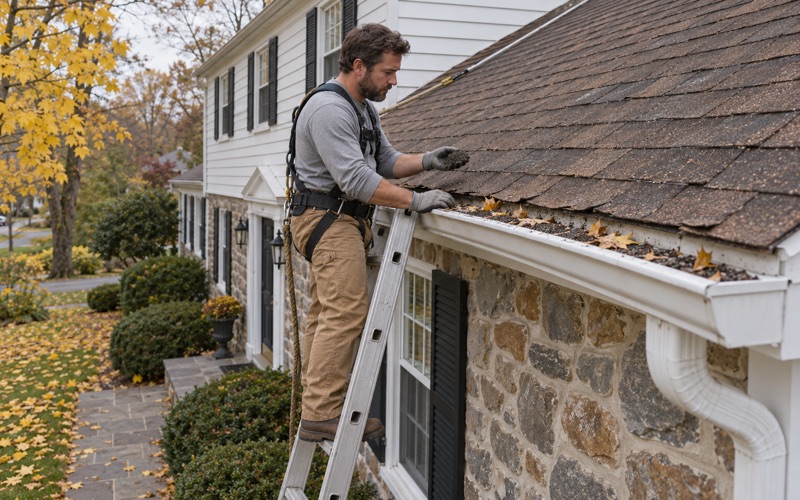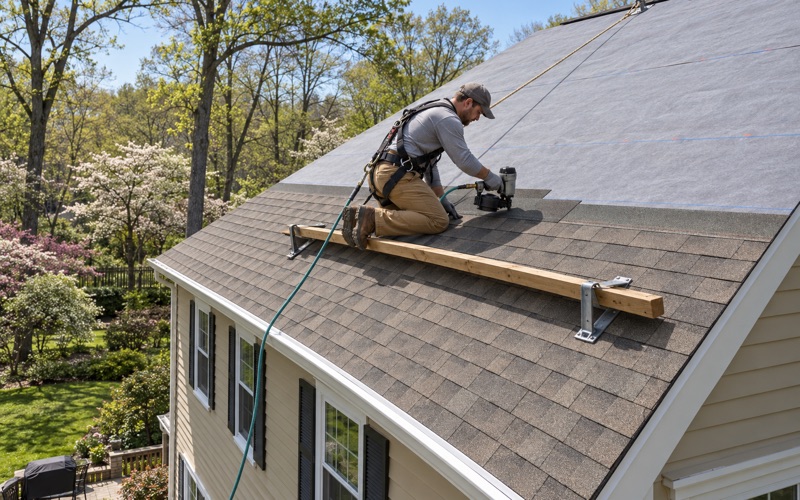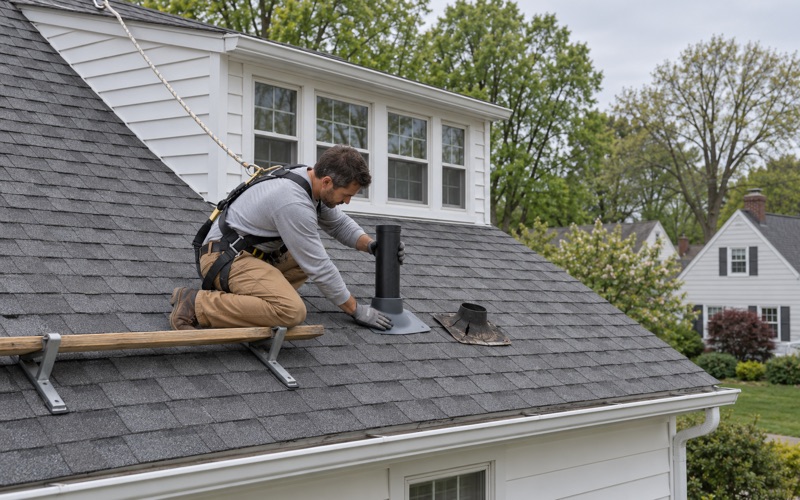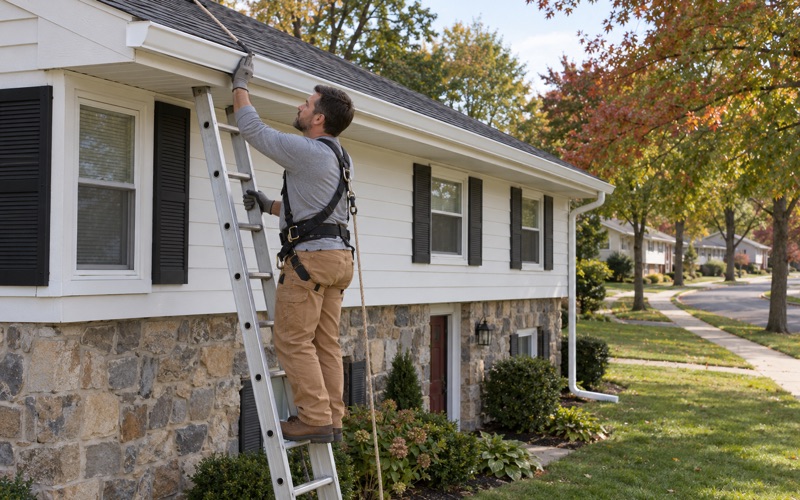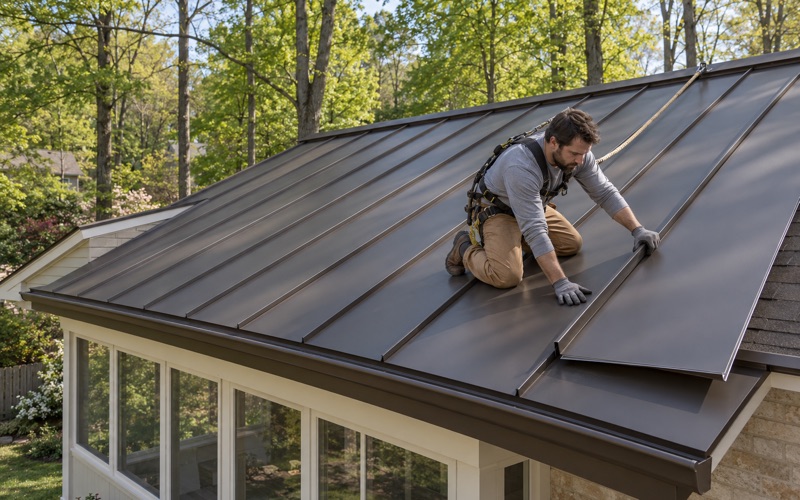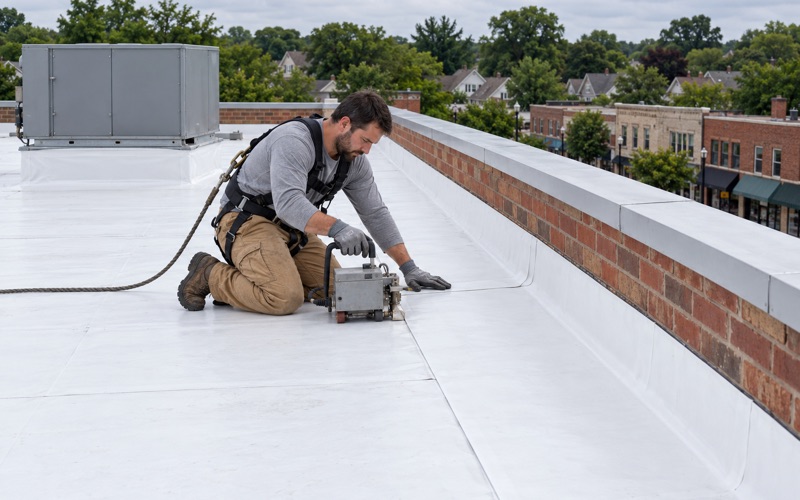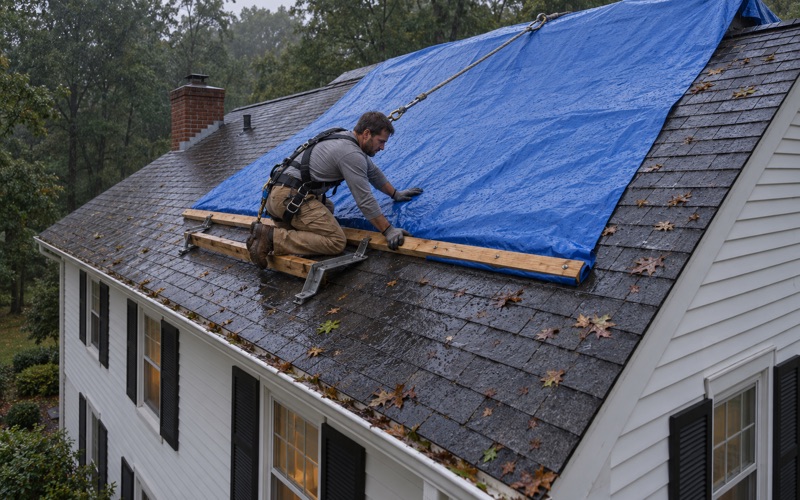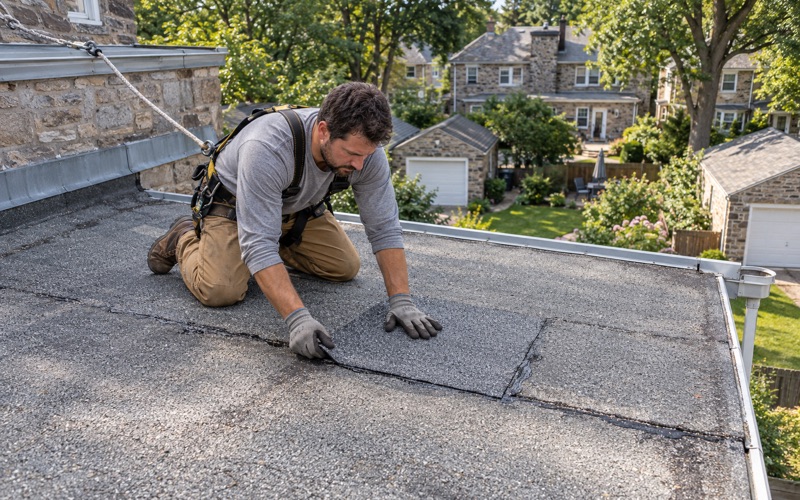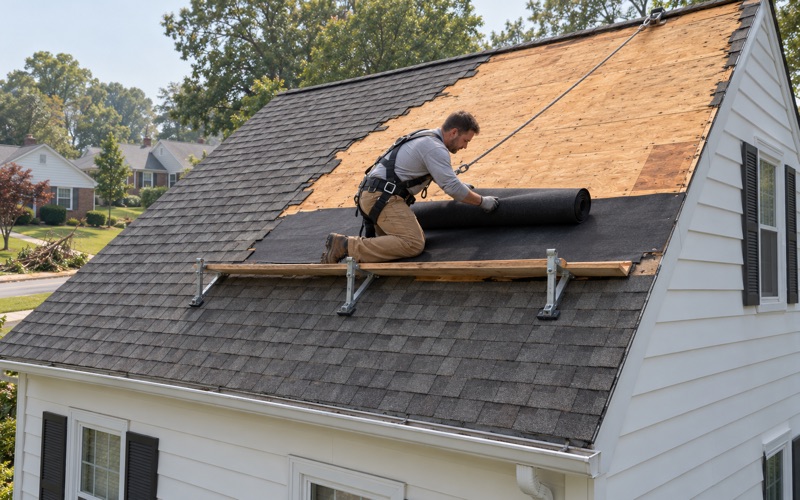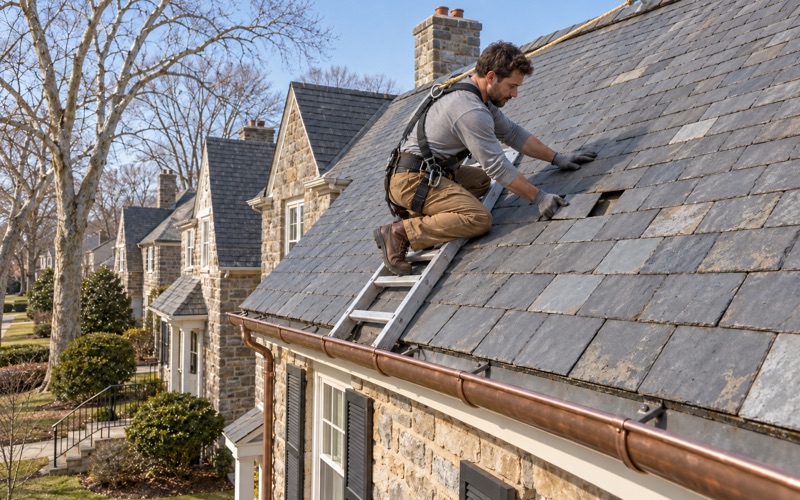
Abington Superior Roofing has spent more than 20 years on roofing in Lower Moreland and the townships around our Abington base, and the work here starts with a question many roofers skip: where does the water go, and where has it gone before? We repair what can be repaired, replace what has to be replaced, and say plainly which is which before anyone talks about a new roof.
Every leak call begins in the attic as well as on the shingles, because a stain on a bedroom ceiling rarely sits under the spot where the water first gets in. We trace the path from the decking down, photograph what we find, and only then put a price on paper. That order keeps a small flashing repair from turning into a quote for a whole roof.
Our written scopes break tear-off, decking, underlayment, flashing, ventilation and gutters into separate lines, so an owner can lay our estimate beside another and compare item by item. Contracts follow Pennsylvania’s home improvement law, including the three-business-day cancellation notice and a deposit kept inside the legal limit. On a house near a creek, that line-by-line scope also matters for a federal rule we explain further down.
Pennypack Creek and the Floods That Reshaped the Township
The September 1999 flood and Tropical Storm Allison
Lower Moreland Township sits in Montgomery County, and Pennypack Creek runs through it. Homes on Chestnut Street near the creek, built in the early 1900s, shared a long flooding history with the nearby Garden Condos, built in the 1960s. A September 1999 flood displaced residents there for about two years, according to FEMA’s account of the township’s recovery.
Two years later, Tropical Storm Allison flooded the same area again. For owners who had only just finished repairs, that second flood was the point where patching stopped making sense. Township officials concluded that residents could not keep living in that stretch of floodplain, and they went looking for a way to move people out rather than rebuild a third time.
The Chestnut Street and Garden Condos buyout
The township turned to FEMA’s Hazard Mitigation Grant Program, which covers up to 75 percent of eligible costs, and added the condos once more funding came through. In all, 35 structures were acquired at a total cost of $2,636,060. The project was finished by 2005, under budget, and a water retention area was built where the residences had stood.
Township Manager Alison Rudolf told FEMA that the project made all the difference for the community. For a roofer, the lesson is narrower and practical. Lower Moreland has already paid to take buildings out of the creek’s path, which means the floodplain here is not a theory on a map. It is a line the township has acted on.
What that history means for a roof estimate
Most roof work never comes near a flood question. A worn roof on a ranch house well up from the creek is a shingle, underlayment and flashing decision. But on a house close to Pennypack Creek, a large roof job can sit inside a federal cost test that has nothing to do with shingles, and the owner deserves to know that before signing anything.
That is why, on any Lower Moreland job big enough to matter, we ask early whether the house is in a mapped flood zone. We do not decide that ourselves, and we never guess from a street name. The answer comes from the township’s flood map and its Code Department, and we build the schedule around whatever they say.
Looking for roofing closer to Upper Southampton? See Roofing Services in Upper Southampton.
Checking Whether Your House Is on the Flood Map
The map Lower Moreland uses today
FEMA’s Community Status Book lists Lower Moreland Township with an initial flood insurance rate map dated March 1, 1978. The current effective map has been in force since March 2, 2016. The township holds no Community Rating System class, so that program gives local owners no discount on flood insurance premiums.
A map that is about a decade old still governs until FEMA issues a new one. That makes the 2016 map, not a memory of where the water reached during the 1999 and 2001 floods, the document that decides whether federal floodplain rules touch a given roof. Neighbors’ stories are useful context, but they do not settle the question.
Looking up a single address
The flood zone is an address-level fact, and we have not read one for any specific Lower Moreland street. An owner can look up the property on FEMA’s public flood map viewer, or call the township’s Code Enforcement office at 215-947-3100 and ask what the effective map shows for the parcel. Either way, the answer should be in hand before a large estimate is final.
If the house sits outside the mapped floodplain, the federal test below does not reach it, and the job is priced on roof condition alone. If it sits inside, the next question is how large the project is compared with the value of the building itself. We would rather surface that during the estimate than halfway through a tear-off.
Each township sets its own rules
Re-roof permit rules differ from one township to the next, so we check the rule for the house’s own township before pricing rather than carrying over what applies at our Abington base. In Abington Township every re-roof needs a township roofing permit, and we schedule that from the first estimate. Lower Moreland has its own Code Department and its own answer, and we confirm it job by job.
Roof Work and the 50 Percent Substantial-Improvement Test
What the federal definition says
Federal flood rules, at 44 CFR 59.1, define substantial improvement as any reconstruction, rehabilitation, addition or other improvement whose cost equals or exceeds 50 percent of the structure’s market value before the work starts. The test is measured against the building’s own value, and it is triggered by cost rather than by the kind of work being done.
The same section defines substantial damage as damage of any origin where restoring the building to its earlier condition would cost 50 percent or more of its pre-damage market value. A building that reaches that line counts as a substantial improvement regardless of the repair work actually performed. A storm, a fallen tree or a fire can all put a floodplain house into that category.
Where a roof job can land
A shingle repair or a straightforward re-roof over a sound deck is a modest share of what a house is worth. Problems start when a roof job grows: a full tear-off, new decking across large areas, rafter repair, a rebuilt chimney, plus interior work after a leak. Bundled together, those lines can push a floodplain project toward the threshold faster than owners expect.
How Lower Moreland applies the test to a particular house, including how it measures market value and whether any earlier work is counted, depends on the township’s own floodplain ordinance. We send owners to the Code Department for that answer rather than guess, and we hold the final price until it is settled.
Why separate scope lines help
Because the test turns on cost, an estimate that lumps everything into one number is hard to measure against it. Itemized lines let an owner or a township reviewer see exactly which dollars belong to the roof covering, which to the deck, and which to the gutters. That clarity costs nothing extra and can save a second round of paperwork.
Decking is the line that moves the most. If rot shows up once the old roof is off, we photograph it and show the owner before any sheet is replaced, at the per-sheet price written into the contract. On a house where the 50 percent figure matters, that step keeps the running total visible as the job goes, rather than surprising anyone at the end.
The exclusions written into the rule
The federal definition carves out two kinds of work. Projects that correct cited health, sanitary or safety code violations are excluded, and so are alterations of a historic structure that keep its historic designation. Whether either applies to a specific house is a question for the township, not for a roofer, but owners should know the exclusions exist before assuming the worst.
Gutters and Downspouts in Three Creek Watersheds
Pennypack, Neshaminy and Poquessing
The township’s stormwater page notes that Lower Moreland lies within three distinct watersheds: Pennypack Creek, Neshaminy Creek and Poquessing Creek. The township holds an MS4 stormwater permit administered by the state Department of Environmental Protection and reports on it every year. Every roof here sheds into one of those three systems, one downspout at a time.
That is not a reason to treat a gutter job as an environmental project. It is a reason to put downspout water somewhere sensible, away from foundations and away from a neighbor’s yard, rather than dumping it at the corner of the house. On lots that slope toward a creek, where a downspout ends deserves as much thought as the gutter itself.
Sizing gutters with the roof
We size and pitch gutters and downspouts as part of the roof plan, not as an add-on after the shingles are down. Seamless aluminum gutters suit most of the township’s houses, and drip edge at the eaves and rakes keeps water landing in the trough instead of behind it. Kick-out flashing where a roof edge meets a wall stops water from running down the siding.
Roof area, pitch and the number of valleys feeding one run all decide how much water a gutter has to carry during a heavy storm. A gutter that overflows at one inside corner every time it rains is usually undersized or poorly pitched, not just clogged. Those are cheap fixes while the roof is already open and costly ones after fascia rot sets in.
Mid-century houses and the attic check
Lower Moreland is overwhelmingly a township of detached, owner-occupied homes. Census estimates count 4,130 of its 4,838 housing units as single-family detached, and 87.4 percent of occupied homes are lived in by their owners. About 45 percent of the housing stock was built between 1950 and 1969, with another 402 units dating to 1939 or earlier.
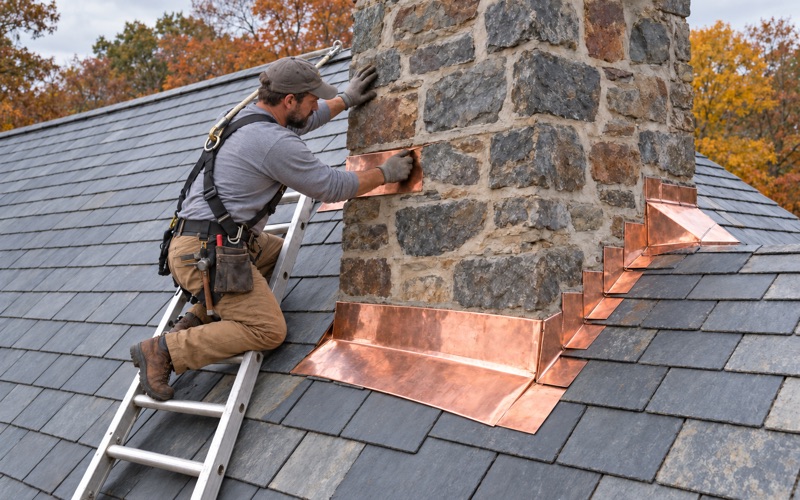
Many houses of that age have been re-roofed at least once, and old ventilation and original flashing are where leaks tend to hide. We replace step, counter and chimney flashing with the roof instead of reusing it, check ventilation from the attic side, and finish every work day by cleaning the driveway, yard and gutters, including a magnet sweep for nails.
- 20+ Years in Roofing
- Free Written Estimates
- Line-by-Line Scopes