Abington Superior Roofing handles roof repair in Abington, PA for homes and small commercial buildings, serving surrounding cities including Lower Moreland, Upper Southampton, East Goshen, Warwick Township and Plymouth Township. With more than 20 years on local roofs, we fix the failures that actually cause leaks: torn shingles, cracked pipe boots, loose step flashing, failing chimney counter flashing and split membrane seams.
Every repair starts with a look in the attic as well as on the roof. Water rarely enters directly above the stain on the ceiling, and a repair priced before the entry point is found is how homeowners end up paying twice. We trace the water to where it gets in, photograph what we find, and only then write the repair scope.
We also give a straight answer on whether your roof can be repaired before anyone talks about replacing it. Plenty of roofs in this area have years of life left and fail at one detail, and those roofs deserve a repair rather than a sales pitch.
Residential Roof Repair: The Failures We Fix Most
Shingle Repair After Wind Damage
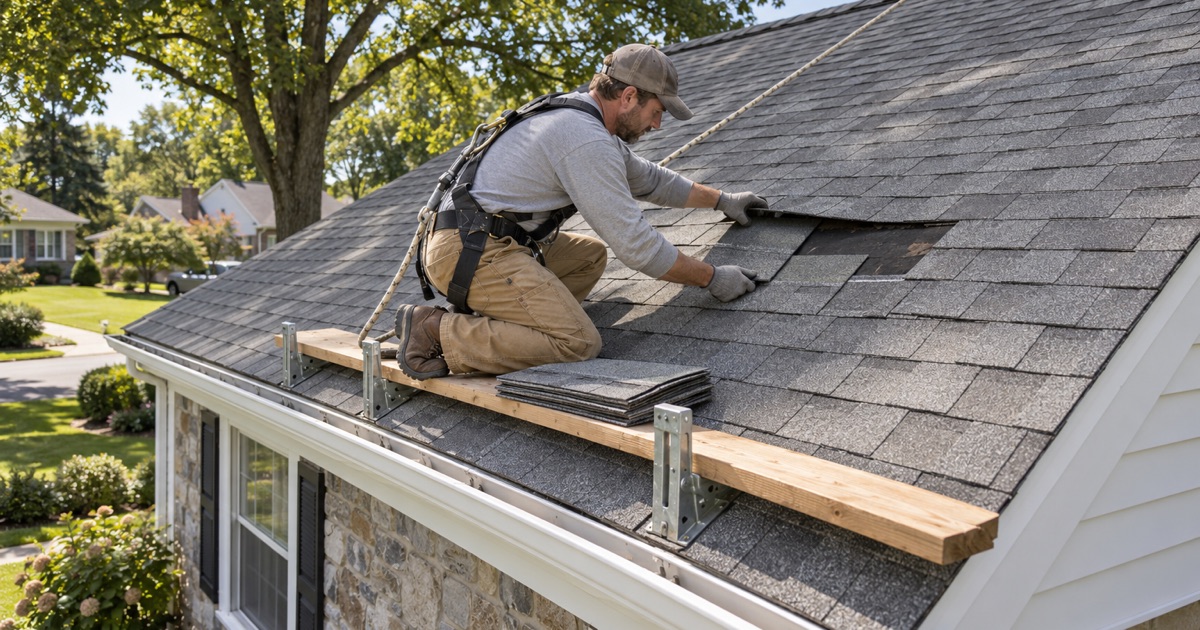
Wind lifts shingles at their seal strip and can tear them off entirely along ridges, rakes and exposed corners. Once one tab goes, the next gust gets under its neighbors, so a small loss grows quickly. Replacing the missing shingles early keeps the damage from spreading across the slope.
We check how well the surrounding shingles still seal and bend before we start, because brittle shingles crack when lifted to slide new ones under them. Where the shingles are sound, we replace the damaged ones with matching material and hand-seal the area. Where they are not, we tell you the repair will be short-lived.
Pipe Boot and Roof Vent Repairs
The rubber collar around a plumbing vent pipe is one of the most common leak sources on any roof. Sun and cold crack the rubber over time, and water runs down the pipe into the attic. The stain usually appears on a bathroom or hallway ceiling below.
We replace cracked boots with new lead boots or long-life boots designed to outlast the shingles around them. We also check exhaust vents and box vents for cracked housings and missing fasteners. These repairs are small, but they stop a large share of the leaks we are called for.
Step Flashing and Wall Flashing Repairs
Wherever a roof meets a vertical wall, at a dormer, a second story or an addition, water is kept out by step flashing woven into each shingle course. When that flashing rusts, was never installed, or was simply caulked over, water runs behind the siding and into the wall.
We remove the siding or trim needed to reach the flashing, install new step flashing course by course, and add kick-out flashing where the roof edge meets the wall. That last piece directs water into the gutter instead of down the face of the wall, which is where rot often starts.
Chimney Flashing and Cricket Repairs
Chimneys leak where the masonry meets the roof. Step flashing along the sides, counter flashing set into the mortar joints and an apron across the front all have to work together, and any gap lets water in. Wide chimneys on the uphill side also need a cricket to split the water around them.
We rebuild failed chimney flashing with new step and counter flashing cut into a reglet, not smeared over with roofing cement. Where a wide chimney has no cricket, we can build one so water and snow stop piling up behind it. Masonry problems such as loose bricks are pointed out so you can have them addressed.
Commercial and Low-Slope Roof Repair
Membrane Seam and Blister Repairs
On modified bitumen, EPDM and TPO roofs, most leaks start at a seam that has opened, a blister that has split, or a puncture from foot traffic. These roofs show their problems slowly, so a small open seam can wet the insulation for months before a stain appears.
We clean and prime the area, then repair it with material matched to the existing membrane so the patch bonds properly. On older roofs we probe the surrounding area for wet insulation, because a patch over saturated insulation will not hold for long.
Parapet Walls, Edge Metal and Drains
Low-slope roofs on commercial buildings and rear additions often fail at the edges rather than in the middle. Loose edge metal, cracked parapet flashing and clogged drains or scuppers all let water in or let it pond. Ponding water then finds every weak seam.
We reset or replace edge metal, rebuild flashing up parapet walls, and clear and reflash drains and scuppers. Where water ponds because of a low spot, we explain the options for improving drainage so the same area does not keep failing.
Rooftop Equipment Curbs and Penetrations
Rooftop units, exhaust fans and pipe penetrations each break the membrane and each need their own flashing. Service technicians walking to equipment also wear paths and puncture the roof. These details account for many commercial roof leaks.
We reflash curbs and penetrations with the correct membrane details and add walkway pads where foot traffic is heavy. We also note any equipment that looks like it is leaking condensate onto the roof, so the right trade can address it.
Repair Decisions, Permits and Matching
When Repair Makes More Sense Than Replacement
A roof with flexible, well-sealed shingles and one failed flashing detail is a repair job, plain and simple. Replacing that roof would spend thousands to fix a problem that a few hundred dollars of correct work solves. We tell you that directly.
Replacement starts to make sense when shingles are curling, cracking and losing granules across every slope, when there are already two layers, or when the decking is soft in several places. Even then, we show you what we saw so you can judge it yourself.
Repair Permits in Abington and Nearby Townships
The Pennsylvania Uniform Construction Code exempts many ordinary repairs from permits, but each township decides how it treats roof work. Abington Township requires a permit for roofing work because it removed the 2018 residential code exemption, while neighboring townships set their own rules.
Before we schedule a repair, we check the rule for your address and tell you whether a permit is needed. If one is, we include it in the schedule and the price, so you are never surprised by an inspector or a stop-work notice.
Matching New Shingles to an Older Roof
Shingle colors change as manufacturers update their lines, and older shingles fade in the sun. Even an exact product match can look slightly different next to shingles that have weathered for ten years.
We bring samples, compare them to your roof in daylight, and choose the closest available match. On a rear slope a small difference rarely matters, but on the slope facing the street we tell you honestly how the repair will look before we start.
Our Step-by-Step Roof Repair Process
Step 1: Attic and Roof Inspection
We start inside, looking at the underside of the decking, rafters and insulation for stains, wet spots and daylight. Then we go on the roof to find the matching failure outside. Photos of both are part of what you receive.
Step 2: A Written Repair Scope
The scope names the repair, the materials and the price, with any permit included. If we find decking damage once the old material is off, it is photographed and shown to you before it is replaced at a price set in advance.
Step 3: The Repair and the Cleanup
The crew makes the repair, seals and checks it, and cleans the gutters and the ground below. That includes a magnetic sweep for roofing nails, so nothing is left behind in the lawn or the driveway.
- 20+ Years in Roofing
- Free Written Estimates
- Line-by-Line Scopes