Abington Superior Roofing provides slate roof repair in Abington, PA on prewar homes, stone houses, churches and older institutional buildings, serving surrounding cities including Lower Moreland, Upper Southampton, East Goshen, Warwick Township and Plymouth Township. With more than 20 years of roofing experience here, we repair slate slate by slate with copper nails and slate hooks before anyone suggests tearing a sound slate roof off.
Slate is one of the longest-lasting roofing materials there is. Many slate roofs in this area are well past the age of an asphalt roof and still have decades left, because the stone itself is fine. What fails first is usually the nails, the flashing or individual pieces broken by ice, branches or careless foot traffic.
That is why slate needs a roofer who knows how to repair it rather than replace it. We start by assessing the slate itself, tell you honestly whether the roof is sound, and then repair what has failed.
Assessing a Slate Roof
Is the Slate Itself Still Sound
Good slate is hard, gives a clear ring when tapped, and holds its edges. Failing slate flakes, delaminates in layers, turns soft or chalky, and breaks easily when handled.
We check slates across every slope, because weathering varies with exposure. If most of the roof is sound, repairs make sense, and if the stone is failing throughout, we explain that clearly and show you why.
Rusted Nails and Slipped Slates
Many older slate roofs were fastened with iron nails that eventually rust through. The slates then slide down the roof one by one, even though the stone itself is in good condition.
A few slipped slates are a normal repair. Many slipped slates across the roof point to widespread nail failure, which we discuss honestly, since the answer may be a large-scale repair rather than replacement.
Inspecting From the Attic
From inside the attic, daylight showing through gaps, water stains on the boards and damp spots near chimneys and valleys show where the slate roof is failing. Many slate roofs sit on board sheathing, which shows stains clearly.
We combine what we see inside with the outside inspection. That way, the repair targets the real leaks rather than every slate that looks slightly different.
How We Repair Slate
Replacing Broken Slates One at a Time
To replace a broken slate, we remove the pieces and cut the old nails with a slate ripper, without disturbing the slates around it. The new slate slides into place matched in size, thickness and color.
Each replacement is fastened with a copper nail through the joint above or a slate hook, depending on the location. The repair is invisible from the street when it is done well.
Copper Nails and Slate Hooks
Copper nails and stainless or copper slate hooks do not rust, so they last as long as the slate. Steel nails and roofing cement, which some contractors use, fail within a few years and leave the slate loose again.
We never glue slates in place with roofing cement. Cement-covered slates are one of the most common signs of past bad repairs, and they often have to be redone.
Matching Color, Size and Thickness
Slate comes from different quarries in different colors, from gray and black to green, purple and mottled shades. Sizes and thicknesses also vary from roof to roof.
We match replacements as closely as possible using salvaged or new slate. Some colors fade to their final tone over time, and we tell you how the repair will look as it weathers.
Working Without Damaging the Roof
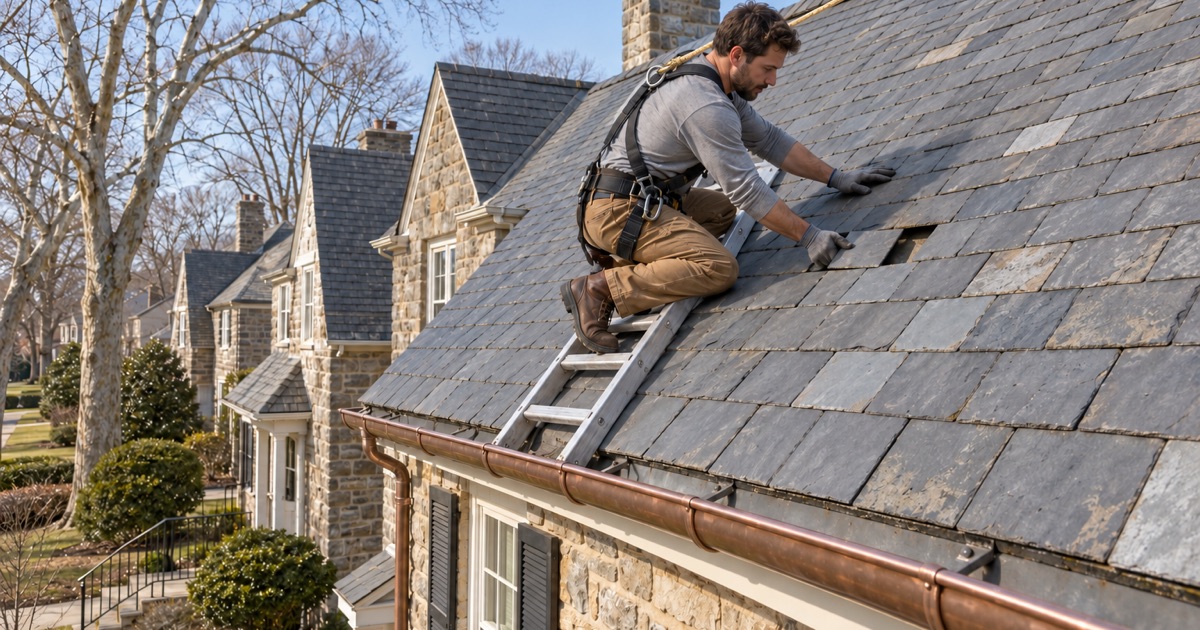
Slate breaks under foot traffic, so we work from roof ladders and padded staging rather than walking on the stone. Fall protection is used on every steep slope.
This takes longer than working on a shingle roof, and it is the only way to repair slate without causing new damage. A roofer who walks on your slate is breaking it.
Copper Flashing, Valleys and Gutters on Slate Roofs
Copper Valleys
Valleys on slate roofs are often lined with copper or other metal, and they carry more water than any other part of the roof. Over decades, the metal can wear thin or crack, especially where debris collects.
We replace worn valley metal with new copper, lifting and reinstalling the slates along the valley edges. A new copper valley can last as long as the slate around it.
Chimney and Wall Flashing
Slate roofs usually have copper or lead flashing at chimneys, dormers and walls. When the seams fail or the counter flashing loosens, leaks appear even though the slate itself is fine.
We rebuild failed flashing in copper, setting counter flashing into the masonry properly. The slates are removed only where necessary and reinstalled with copper nails.
Half-Round Copper Gutters
Half-round copper gutters are common on slate houses, and they suit the roof both in appearance and lifespan. When they leak at seams or pull away from the fascia, they can usually be repaired rather than replaced.
We resolder seams, reset hangers and replace damaged sections with copper. Mixing aluminum or steel parts into a copper system causes corrosion, so we keep the metals consistent.
Slate Roof Repair Decisions
Repair Before Replacement
A slate roof with sound stone and failing nails or flashing is a repair job, even if it needs a lot of repair. Tearing off a sound slate roof to install asphalt shingles trades a roof with decades left for one with far less.
We give you a straight answer on whether the slate can be repaired before replacement is ever discussed. When replacement truly is needed, we explain what we saw and what your options are.
Snow Guards and Ice
Snow slides off slate roofs in sheets, and the falling snow and ice can break gutters, plants and slate on lower roofs. Older slate roofs often had snow guards that have since broken or fallen off.
We replace missing snow guards in a pattern suited to the roof, especially over entrances and lower roofs. They protect the slate, the gutters and anyone walking below.
- 20+ Years in Roofing
- Free Written Estimates
- Line-by-Line Scopes