Abington Superior Roofing has spent more than 20 years on roofing in Towamencin and the townships around it, and much of our work here begins with a question the shingles cannot answer: who is responsible for this roof? A large share of the township’s owners live in attached homes, and for them the first step is reading the community’s own documents, not climbing a ladder.
When a leak is reported, we look in the attic as well as on the roof, and we give a straight answer on whether a repair will hold before anyone talks about replacement. On an attached home that matters twice over, because water coming in at a shared wall can show up in the unit next door before it shows up in yours.
Our written scopes break tear-off, decking, underlayment, flashing, ventilation and gutters into separate lines. That makes two bids easy to compare item by item, and it lets an association board or manager see exactly which parts of a job fall on which side of the line their documents draw.
Who Replaces a Towamencin Townhouse Roof: Owner or Association
A quarter of owner households share a wall
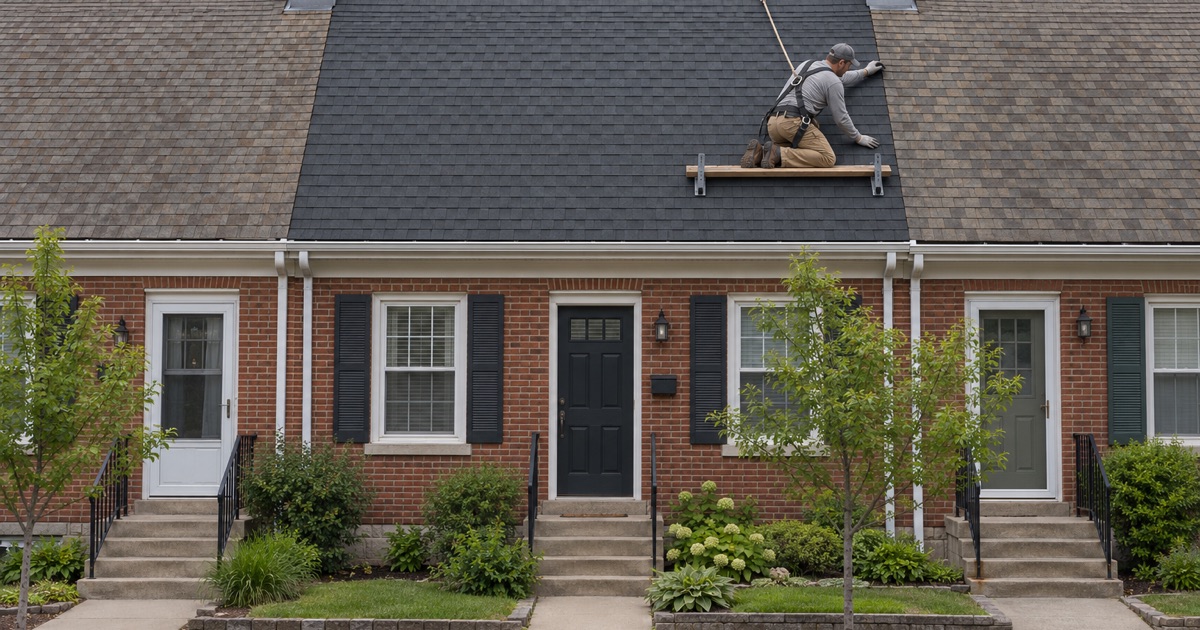
The American Community Survey’s 2024 five-year figures count 1,220 single-family attached homes among the 4,877 owner-occupied units in Towamencin Township. That is about one owner household out of every four living in a townhouse or similar attached home, sharing at least one wall and usually a continuous roofline with a neighbor.
Many of those homes sit in planned communities with an association, a monthly fee and a set of recorded documents. What the fee pays for differs from one community to the next, so the answer to the roof question differs as well.
What a fee covers is not always spelled out
One listing for a 1969 unit at Chatham Village of Towamencin describes a $433 association fee that includes exterior building maintenance, hot water, lawn maintenance, trash and recycling, and snow removal. The listing does not name the roof at all.
Exterior maintenance can mean a great deal or very little depending on how the governing documents define it. We do not assume a roof is covered because a fee sounds generous, and we do not assume it belongs to the owner because a listing is silent. We ask to see the actual language first.
Towamencin’s setting and forecast zone
Towamencin covers 9.68 square miles of Montgomery County in the North Penn Valley, with villages including Kulpsville, Inglewood and Oak Park, and easy access to the Northeast Extension of the Pennsylvania Turnpike. Residential neighborhoods sit alongside historic farmhouses, open space and employers such as SKF’s North American headquarters.
The township falls in the National Weather Service forecast zone PAZ103, Western Montgomery, served by the Mount Holly office. That zone carries the forecasts and winter weather alerts that tell a crew when tear-off on a row of attached roofs should wait, since an open roof on one unit leaves the shared wall exposed as well.
Looking for roofing closer to Gloucester City? See Gloucester City Roofing.
What the Declaration Decides Under Pennsylvania’s Planned Community Law
The default split in the Uniform Planned Community Act
Pennsylvania’s Uniform Planned Community Act, at Title 68, Section 5307(a), sets a starting point. The association is responsible for maintenance, repair and replacement of the common elements, and each unit owner is responsible for maintenance, repair and replacement of his own unit.
That default applies except to the extent the declaration provides otherwise, and it is also subject to the statute’s insurance section. So the law does not say that roofs belong to owners or to associations. It sets a general split and then leaves the specific answer to each community’s declaration.
Reading the declaration before we price the job
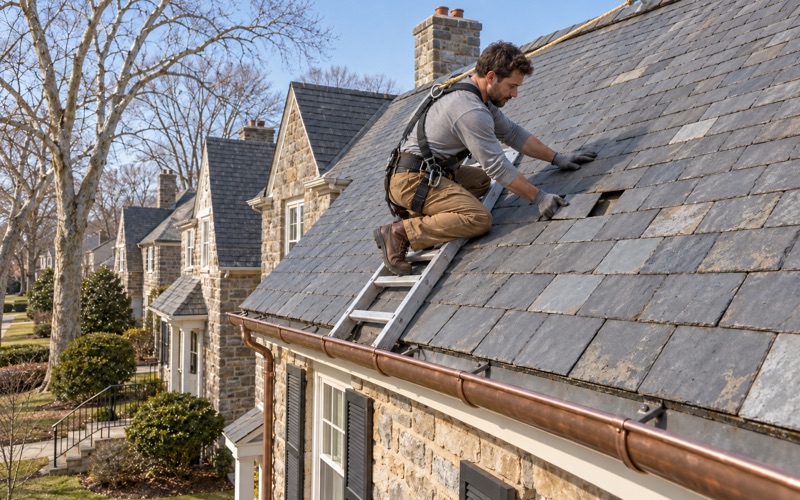
When a townhouse owner in Towamencin calls us, we ask for the declaration and any maintenance chart or rules the association has adopted. Those papers should show whether the roof covering, the sheathing, the gutters and the flashing at the party wall are part of the unit or part of the common elements.
If the association handles roofs, the owner may still need a repair answer for an active leak while the board works out timing. If the owner handles them, the scope is theirs to approve. Either way, the estimate names each part separately, so nobody has to guess which line belongs to whom.
When responsibility is divided
A declaration can divide a roof between parties, giving the covering to the owner and the structure to the association, or the reverse. It can also treat a whole building as one common element. We never tell a Towamencin owner which pattern their community follows until the document is in hand.
That caution protects the owner as much as it protects us. A roof replaced on the wrong assumption can leave an owner paying for work the association owed, or an association facing a claim over work it never approved. Ten minutes with the declaration prevents both outcomes.
Reserves and the Resale Certificate Before You Buy or Sell
What the resale certificate must disclose
When a unit in a Pennsylvania planned community is resold, Section 5407 of the same act requires the seller to furnish the declaration, bylaws, rules and a resale certificate. The certificate must state any capital expenditures the association proposes for the current fiscal year and the two that follow.
It must also state the amount of reserves for capital expenditures, along with any portion of those reserves set aside for a specified project. For a buyer looking at a Towamencin townhouse, those two statements are where a planned roofing program would show up, if the association has one.
Reading the numbers with the roof in mind
A large proposed capital expenditure next to thin reserves can point toward a future special assessment. A reserve earmarked for roofing suggests the board has been planning for it. Neither line tells you the condition of the roof over your own unit, which is why we treat the certificate as a starting point rather than an answer.
If the declaration puts the roof on the owner, the reserve figures may not touch it at all. In that case the buyer is taking on the whole roof, and an inspection that includes the attic, with a plain read on remaining life and on whether repair is realistic, belongs in the decision.
Timing, the ten-day rule and the buyer’s window
The association must furnish the certificate within ten days after a unit owner requests it. Under Section 5407(d), the purchase contract is voidable until the certificate is provided and for five days after that, or until conveyance.
That window is the practical moment to have the roof looked at. Sellers who plan to list in the next few years can ask the board early how roofs appear in the capital plan, and owners responsible for their own roof gain a cleaner story for the next buyer with an itemized scope on file.
Re-Roofing One Attached Unit and Towamencin’s Permit
Planning around the shared wall and the neighbor’s roof
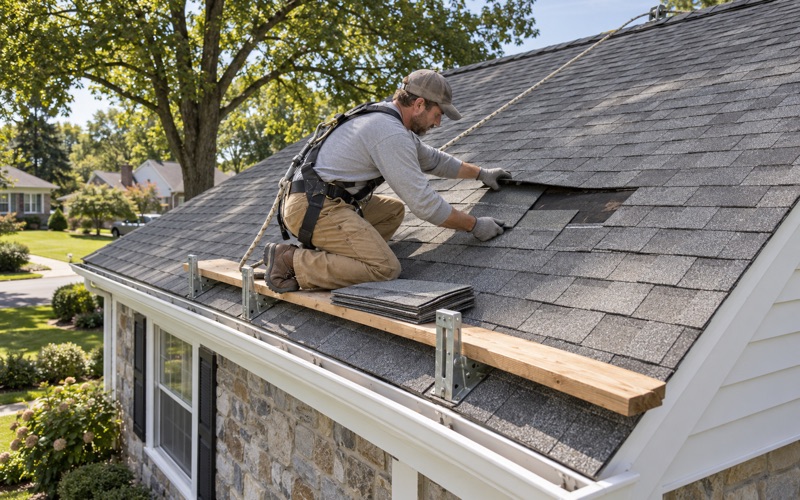
When one owner in a row replaces a roof and the neighbors do not, the new roof has to meet the old ones cleanly. We plan the tie-in at each party wall, the flashing where roof planes meet, and the exact line where one owner’s work stops, with the neighbor’s roof and the shared wall in mind from the first visit.
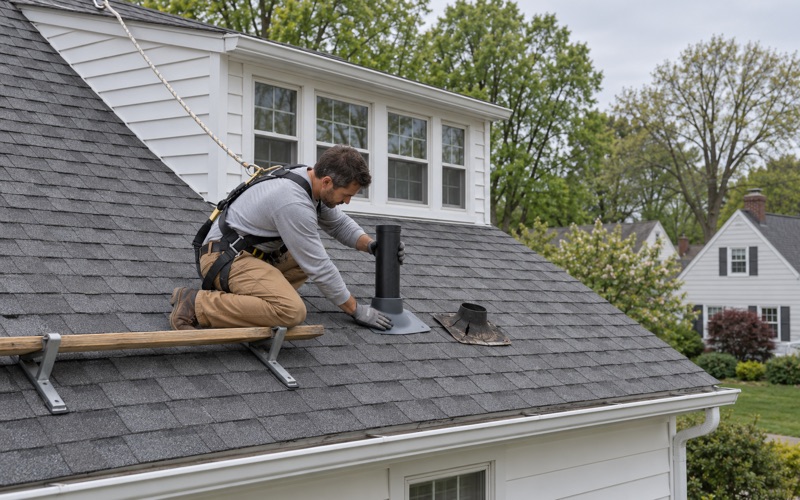
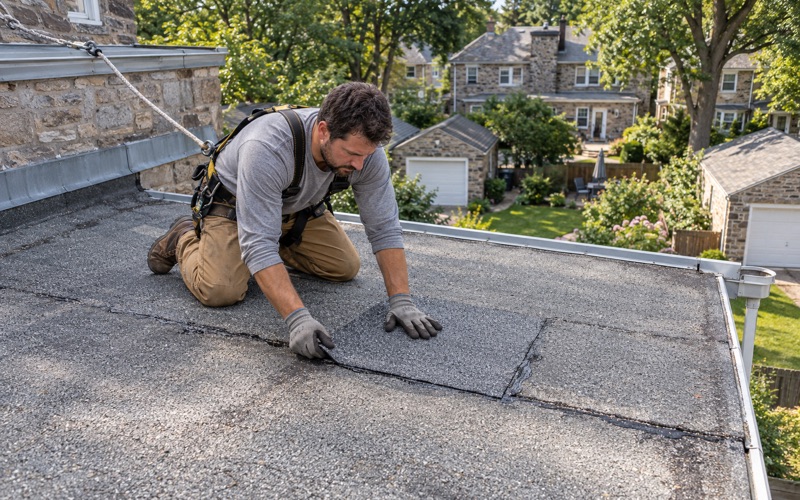
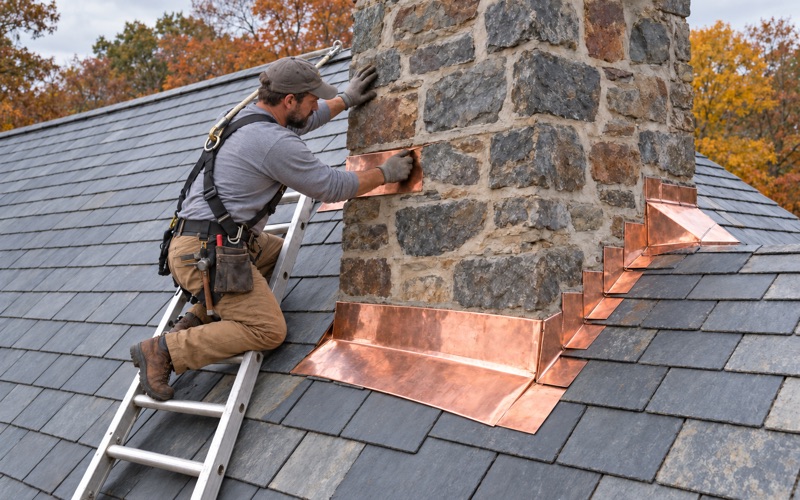
Step, counter and chimney flashing is replaced with the new roof rather than reused under it. On attached homes that includes the flashing along any wall that rises between units, where tired old metal left in place is a frequent source of leaks that surface in the unit next door.
Decking, photos and daily cleanup
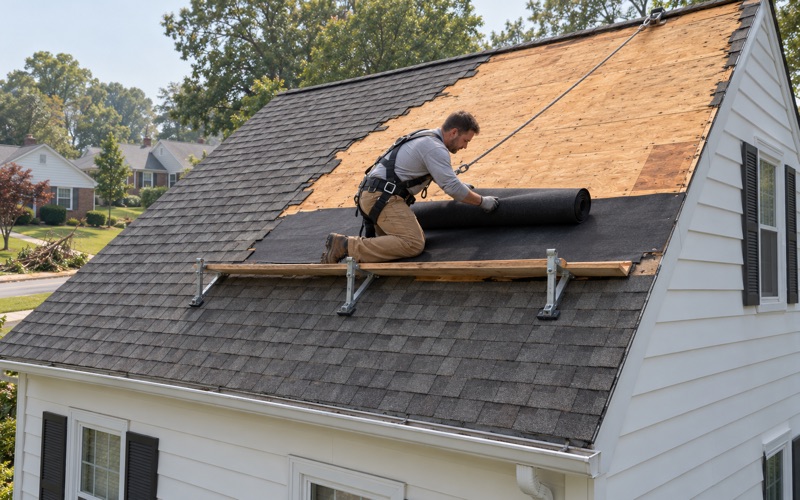
Once the old layers are off, the condition of the decking becomes visible. Damaged sheets are photographed and shown to the owner before we replace them, at a per-sheet price fixed in the contract. Where an association shares the cost or approves the work, those photos give the board the same evidence the owner sees.
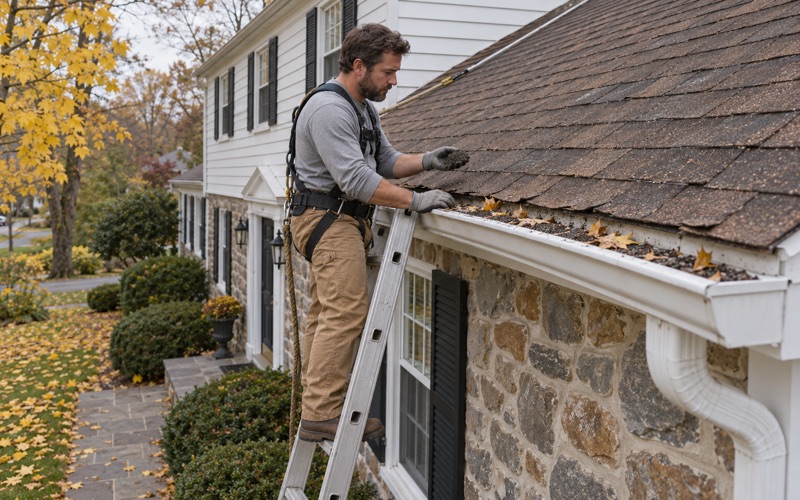
At the end of each work day the driveway, yard and gutters are cleaned and the ground is swept with a magnet for roofing nails. In a row of townhouses with shared walks and close parking, that cleanup protects the neighbors’ tires and walkways as much as the owner’s.
What the township’s roofing permit form asks for
Towamencin Township issues a dedicated Roofing and Siding Replacement permit covering single-family homes and multi-family buildings. The current form, revised April 2025, asks for the development name, the type of rated separation between units, whether masonry, a rated assembly or other, and the total number of rated wall and floor separations per building.
Those questions reflect how attached buildings depend on rated walls between units, and a re-roof that crosses or caps those walls has to respect them. We collect the development name and separation details before submitting, and we schedule the required final inspection with at least 24 hours of notice, as the form asks.
The checklist and the ice barrier at the eaves
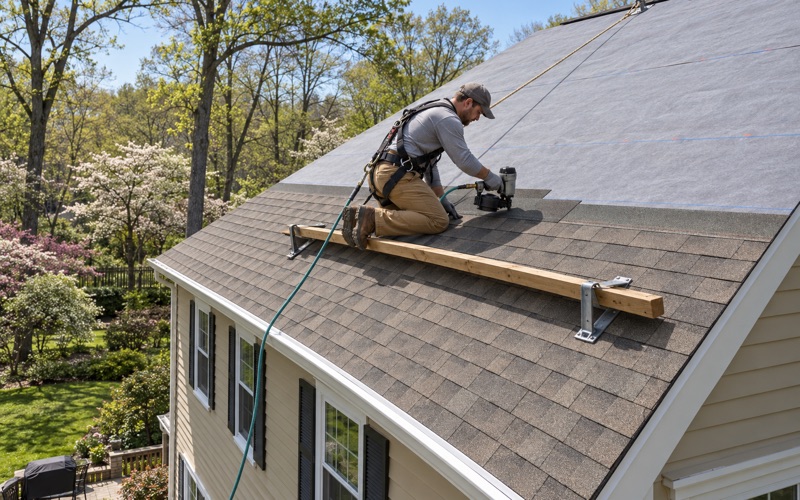
The township’s residential checklist asks for compliance with the 2015 International Residential Code, the roof slope, the underlayment and roofing material with catalog spec sheets, and the flashing material. It also calls for an ice barrier extending 24 inches minimum inside the exterior wall line at the lowest roof edges.
That is Towamencin’s own requirement, not one we would carry to a neighboring township. Each township we serve sets its own re-roof permit rule, so we confirm the rule for the house’s own township before we price the job. Applications go to the township office at 1090 Troxel Road, Lansdale, which does not accept submissions by email.
- 20+ Years in Roofing
- Free Written Estimates
- Line-by-Line Scopes