Abington Superior Roofing has handled roofing in Worcester for more than 20 years, and on wooded properties the trouble often starts with a tree. A limb, a sheared top or a whole trunk can turn a sound roof into an open one in seconds. We repair what falls on a roof and tell owners plainly what to look for after the next storm.
The first question we answer on any call is whether the roof can be repaired, and we give that answer before a replacement is ever on the table. For leaks, we look in the attic as well as on the roof, so the water is traced to the place it really enters before anything is priced.
Our written scopes put tear-off, decking, underlayment, flashing, ventilation and gutters on separate lines. That lets an owner hold our number against another contractor’s line by line. It matters most after a storm, when several roofers may be knocking on the same doors in the same week.
The 2020 Isaias Tornado and Worcester’s Big Trees
What the Weather Service Surveyed
On August 4, 2020, as Tropical Storm Isaias moved north, a brief EF0 tornado formed near Brindle Court and Township Line Road. The National Weather Service office at Mount Holly surveyed the path and put its peak wind at 80 mph. The track ran 2.8 miles, reached 200 yards wide, and both started and ended inside Worcester Township.
The whole event lasted about six minutes that morning. The survey describes trees down along Potshop Road, a denser stretch of downed trees across Valley Forge Road, and several hardwoods felled along Hollow Road, one of which pulled down utility lines as it fell. The useful detail for a homeowner is which trees came down: mature hardwoods, not only small trees.
Heebner Road and the Sheared Treetops
The survey singles out Heebner Road, where the tornado moved northwest after crossing Valley Forge Road. Several treetops were sheared off there, and utility poles were pushed over near Shefley Lane. Wind strong enough to snap the top off a mature tree is strong enough to drop that top onto whatever sits below it.
We want to be accurate about the record. The survey reports trees and utility poles down, not damaged houses or roofs. We point to it because it shows what an 80 mph gust can do to the canopy over a Worcester lot, and that canopy is what a homeowner here should be watching.
Two-Acre Lots Under a Mature Canopy
In the township’s AGR Agricultural District, the zoning ordinance sets an 80,000-square-foot minimum lot, about 1.84 acres, and a 250-foot minimum lot width. The district’s stated intent includes limiting the effects of development on woodlands. The practical result is many houses set among trees rather than on cleared ground.
Of the township’s 4,060 housing units, 2,651 are single detached houses, and 1,379 were built during the 1990s. Trees planted or spared around those homes have had three decades to grow, and on many lots the hardwoods now stand taller than the ridge line. A tree taller than the house can reach the roof from well back in the yard.
Center Point and the Older Villages
Worcester Township was founded in 1733 and takes in several villages, including Center Point, Fairview Village, Cedars and Heebnerville. The housing count includes 307 units built before 1940, and an older home in Center Point or anywhere else in the township calls for a slower look before any work begins.
On a house built before 1978, painted fascia and trim fall under the EPA lead-safe rule for renovation work, so we plan for it when a limb has torn the eave. We also check the age and condition of the decking before treating a tree strike on an old roof as a simple shingle patch.
Looking for roofing closer to Collingswood? See Roofing Services in Collingswood.
What a Falling Limb Does to Shingles, Decking and Gutters
Shingles and Underlayment
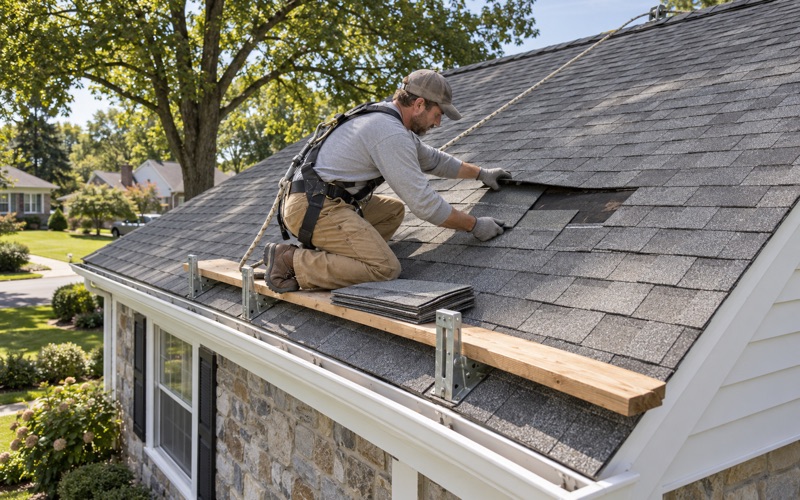
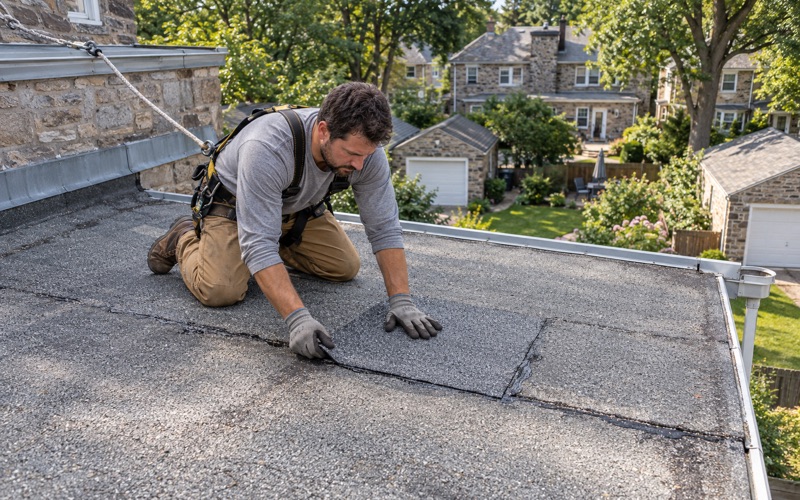
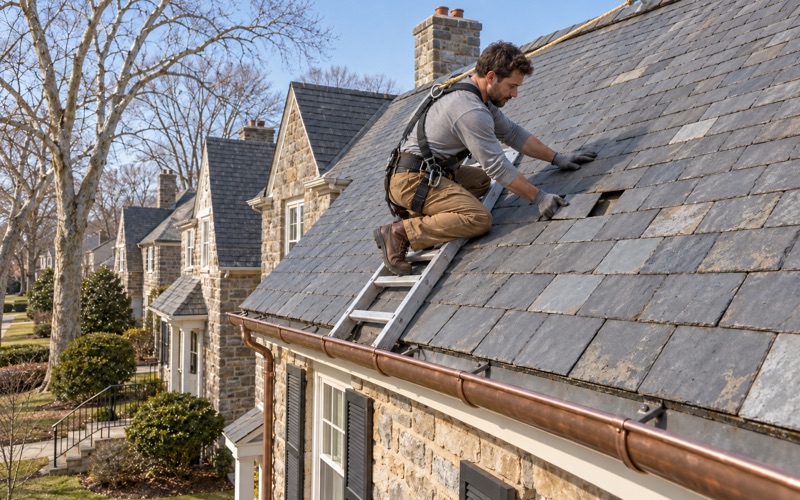
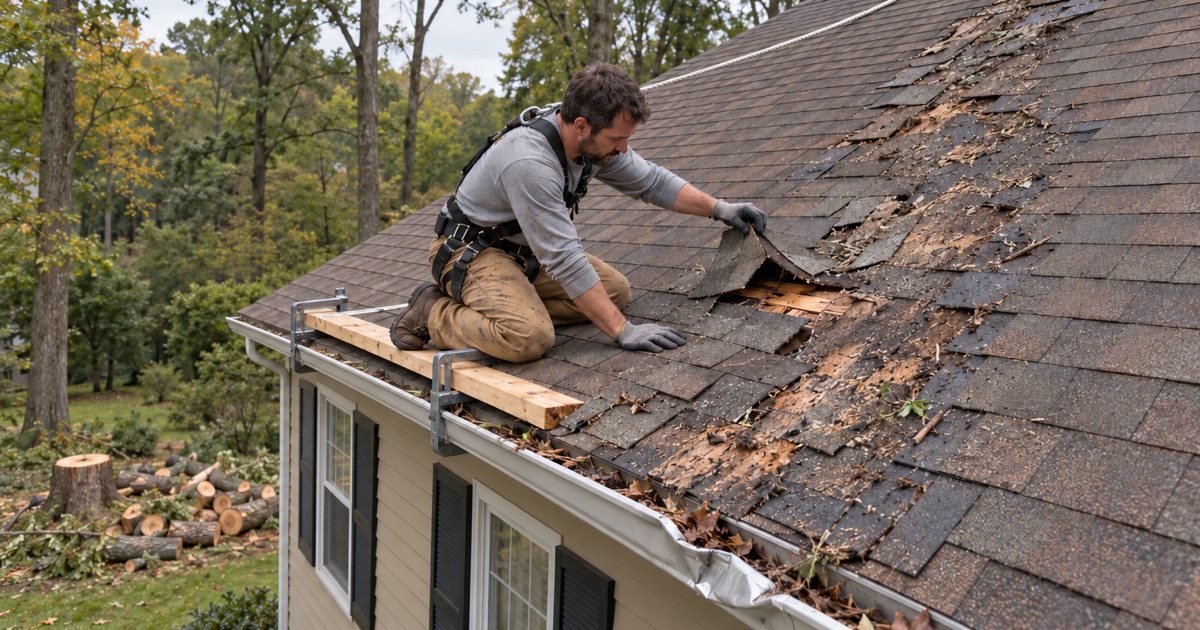
A limb that lands flat may only crack architectural shingles and break the seal strips that hold each course down. A limb that lands on its end can punch straight through. Either way, the damage often runs wider than it looks from the yard, because loosened shingles around the impact let wind-driven rain work under the courses.
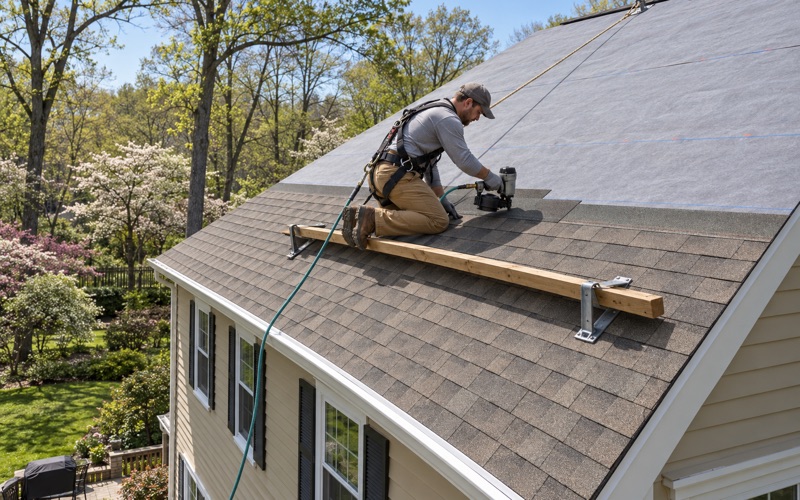
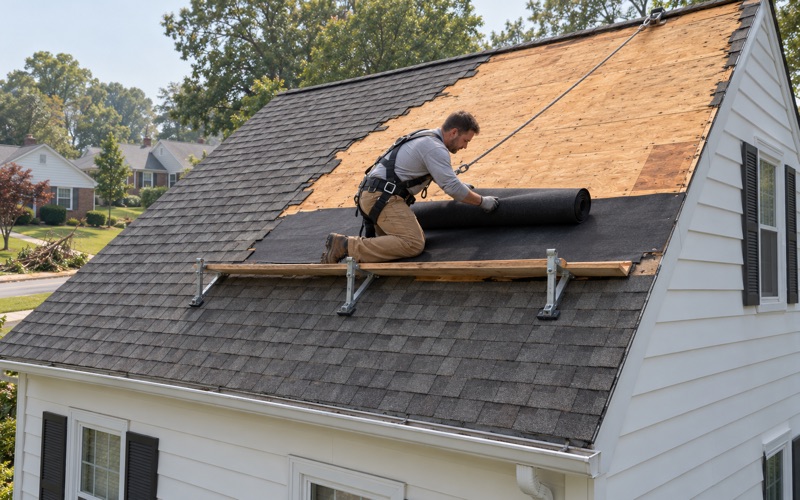
We replace the damaged shingles and the underlayment beneath them rather than sliding new tabs over a torn layer. Where a larger section has to come off, we use shingles with a published wind rating, such as ASTM D3161 Class F or ASTM D7158 Class H, which is worth having on a lot where gusts have already found the trees once.
Decking and Rafters
A heavy trunk can crack the roof decking or push a rafter out of line. We do not guess about that from the ground. Once the damaged area is opened, any broken or rotted decking is photographed and shown to the owner before it is replaced, at the per-sheet price written into the contract.
A cracked rafter or truss is structural work beyond a roofing repair, and we say so plainly when we find one. From the attic side, a split rafter or a punctured sheet is often easier to see than it is from the shingles, which is one more reason the attic is part of every inspection.
Flashing, Vents and Gutters
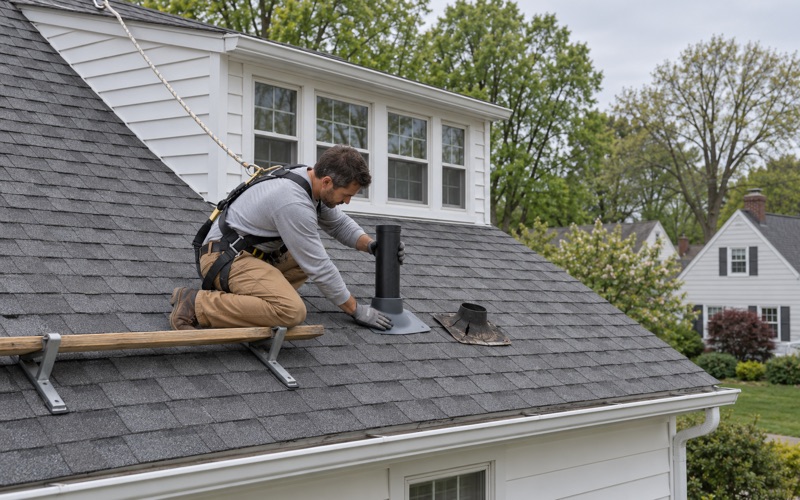
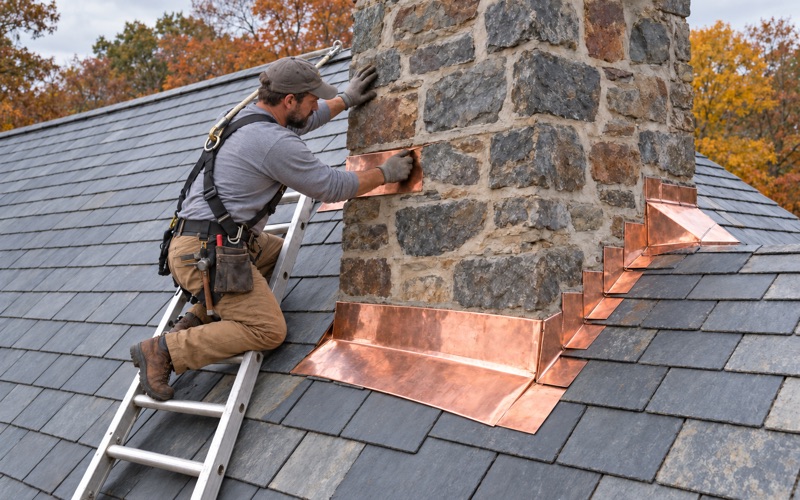
Falling limbs tend to catch whatever sticks up from the roof or hangs off its edge. Pipe boots get crushed, ridge vent caps split, and chimney flashing gets bent away from the masonry. When we repair or replace that area, step, counter and chimney flashing is replaced with the roofing rather than reused under new material.
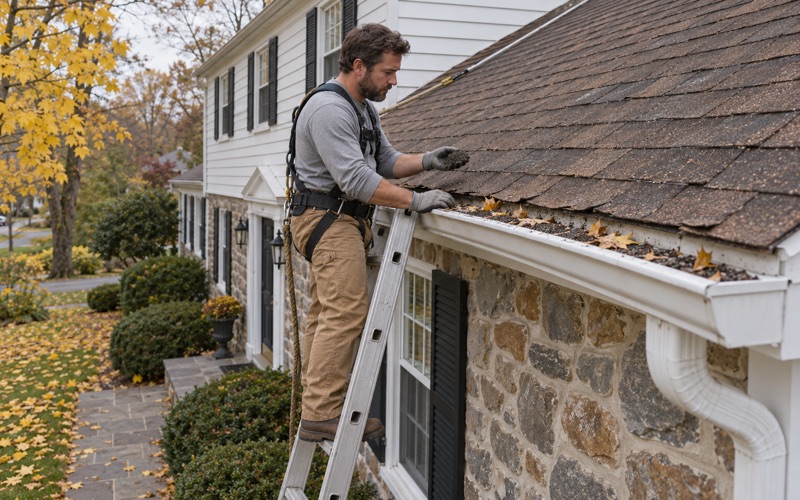
Gutters often take the first blow, since limbs slide off the roof and land on the eave. A bent seamless aluminum run pulls on its hangers and can lose its pitch toward the downspout. When gutters need replacing, we size and pitch them with the roof, so runoff from a large roof under heavy leaf fall actually reaches the downspouts.
Checking the Roof After a Wind Event
Start From the Ground
After a storm passes, start on the ground and stay there. Look for broken limbs still hanging in the canopy, since they can drop days later. Scan the roof from several angles for missing shingles, a dented ridge or branches resting on the surface, and never climb onto a wet roof under damaged trees.
Walk the gutter line too. A gutter pulled off the fascia or a downspout knocked loose is often the first sign that a limb struck the eave. If utility lines came down with a tree, as one did along Hollow Road during the 2020 tornado, stay well clear and call the utility before anyone goes near the lines.
Inside the Attic
The attic tells the rest of the story. With a flashlight, look for daylight through the decking, wet insulation, water stains on the rafters or roofing nails pushed down through the sheathing. A small puncture under a limb strike can leak slowly for weeks before a ceiling shows a stain.
Water does not always drip where the limb hit. It can run along a rafter or the top of a ceiling joist and show up several feet away. Tracing it from inside is how we decide whether the repair covers only the impact point or a wider section of the roof.
Photos for Your Insurance Claim
If you plan to file with your insurer, photograph the damage before the tree is cut up, as long as it is safe to do so. We document storm damage with photos and a written report that the owner submits with their own claim, and our crew will meet the adjuster on site when asked.
We do not negotiate the claim; that conversation stays between you and your insurer. The Pennsylvania Insurance Department publishes homeowner guidance on how claims are handled, and it is worth reading before the adjuster arrives.
Tree Work and Roof Work in the Right Order
Lift the Tree Off Before the Roof Is Opened
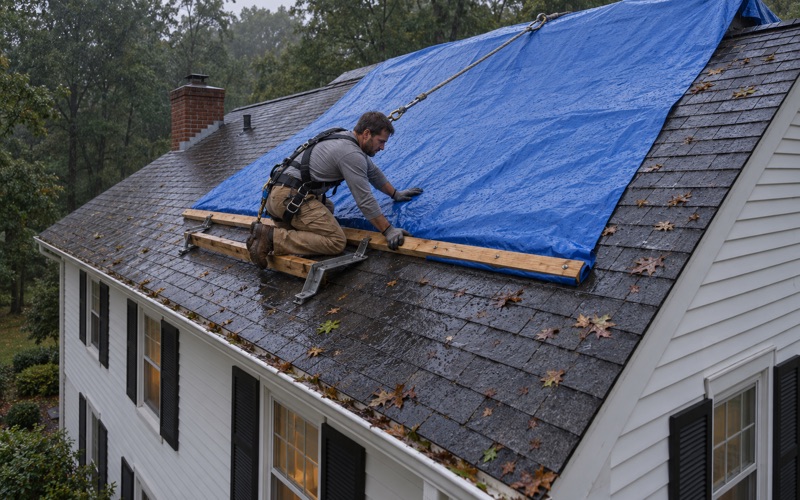
No roofer should be working on a roof that still has a trunk lying across it. The tree service goes first, lifting the weight off in sections so the roof is not damaged a second time on the way out. If the full repair has to wait for materials, we tarp the opening so the house stays dry in the meantime.
Ask the tree crew to clear branches out of the gutters and off the valleys before they leave. It saves time when we arrive, and it lets us see the eave, the fascia and the drip edge clearly instead of guessing at what lies under the debris.
Trimming Back From the Roofline
On a wooded lot of nearly two acres, the long-term fix is often keeping branches off the roof in the first place. Limbs that rub the shingles wear away the granules, and leaves packed into valleys hold water against the roof. An arborist can tell you which overhanging trees are worth thinning or removing.
Heavy shade also slows how fast a roof dries after rain. We plan the ridge vent and soffit intake with that in mind, and we check whether leaf debris has blocked the soffits, since an attic that cannot breathe holds moisture against the underside of the decking.
Permits, Contracts and Cleanup
Re-roof permit rules in Pennsylvania are set township by township, so we never assume one township’s rule applies in another. For a house here, the Worcester Township Codes Department is the office we check with before pricing the job, and any permit it requires goes into the schedule from the start.
Our contracts follow the Pennsylvania Home Improvement Consumer Protection Act, with the three-business-day cancellation notice and a deposit kept within the legal limit. At the end of each work day, we clean the driveway, the yard and the gutters and run a magnet sweep for roofing nails across the lawn.
- 20+ Years in Roofing
- Free Written Estimates
- Line-by-Line Scopes